Season Six of Buffy the Vampire Slayer concerns Buffy’s troubles with finding her way in the world. After dying (at the end of season five), and being resurrected, Buffy is having some problems finding her purpose in life. In the musical episode, “Once More With Feeling,” she sings that she just wants to “feel” and that she wants “something to sing about.” Spike sings to her, “Life's not a song/ Life isn't bliss/ Life is just this/ It's living.” (I know that sounds uber-corny, but trust me, the show is masterful at making the trite meaningful. Plus the way Spike – James Marsters – looks at Buffy at this moment is enough to make your socks melt).
ANYWAY, I love me this stuff, but as many times as I watch this episode, I’m always left sitting there thinking, “Come on Buffy, what the crap? You have super-slayer powers, a dreamy dude worshipping you, a stylish yet affordable wardrobe, cool friends, and perpetually shiny and bouncy hair. What is it you’re sad about again?”
And then I am spiraled into self-reflection, because I know it’s true that I complain too. But I know I shouldn’t. I have a lovely life. I am paid to read books that interest me and to talk about them and write about them in a beautiful place with smart people. I think of my friend Maggie at Mizzou who would talk about how she drove a forklift for ten years before coming to grad school. And why am I complaining again? And as much as I complain about teaching, it brings me incredible joy. Seriously. I woke up at 5:30am this morning because I was so excited about creating a lesson plan centered on Jeopardy. That’s joy.
So I’ve decided to just not complain anymore, because every time I complain, I am giving myself permission to be ungrateful for the good things I’ve got. I am giving myself permission to NOT “be here now,” to NOT “be mindful,” to live in some fantasy world where I’m thinner, have a car, and everyone thinks I’m smarter than they are.
I am currently reading Thomas Merton’s Zen and the Birds of Appetite, and I find that Merton makes a similar point: “I might suggest a fourth need of modern man, which is precisely liberation from his inordinate self-consciousness, his monumental self-awareness, his obsession with self-affirmation, so that he may enjoy the freedom from concern that goes with being simply what he is and accepting things as they are in order to work with them as he can.”
So here are some ground rules:
1. I am only allowed to “complain” to people who can do something about it. So if for example, I have a problem with a professor, I am only allowed to talk to the professor about it. This will also keep me from gossiping.
2. I am only allowed to complain about things that I can change or that can be changed (the wisdom to know the difference, etc.)
3. Before I complain, I’m going to think about how my complaining might come off to someone who, for example, has to work 60+ hours a week in customer service for less money than I make. In short, I want to look at myself the way I look at Buffy.
4. I am allowed to debate, analyze, and criticize for the purpose of furthering my own beliefs or for the benefit of others. For example, I can criticize a book we read for class, and discuss what I don’t like about it, but I am not allowed to complain that we have to read it in the first place.
We shall see how this works. I’m already feeling more positive.
Showing posts with label Reading. Show all posts
Showing posts with label Reading. Show all posts
Tuesday, September 25, 2007

Thursday, September 13, 2007
That Quiet Kid
It happens every semester.
There is one student (in my mind, usually male) who never talks. Sometimes he's in the back, sometimes he's in the front, but he just sits there and stares (sometimes under the brim of a baseball hat).
Then, inevitably, this kid writes a brilliant paper. And everything you said on the first day of class about the importance of participation, about how you have to talk to learn, about how we're all in this together and you have to contribute to learn right along with everyone else, etc. doesn't make sense. Because this kid said like one or two things the entire class thus far and yet seemed to get it more than anyone else.
I was always baffled about why this happened, up until this last week reading Living Speech by James Boyd White. White argues that much of what we say is "dead" speech -- cliches, empty phrases, chatter, propoganda -- it lacks meaning and life. He discusses briefly Quaker church services and Trappist monks, both of which are marked by silence. In a Quaker church service, everyone sits in silence until someone feels as though he or she has something meaningful to say. Similarly, the monks take a vow of silence not to alienate others but to clear away the clutter of daily life, to perhaps hear God better. (Though perhaps not as erudite of an example, there's an episode of Buffy where everyone loses their voice -- a similar point is made about how little of what we say actually means anything.) I mentioned this (the silent student, not the Buffy ep) to my professor, who remarked that studies of gifted children show that they spend a good portion of their day staring out the window.
I believe in silence in the classroom. After I ask a question, I usually let the silence stretch for quite some time -- silence gives students time to think. Sometimes you can't just answer a question right off the bat. Sometimes you need to look at your notes, or the reading, or the book, or sometimes you just need to stare out the window.
There is one student (in my mind, usually male) who never talks. Sometimes he's in the back, sometimes he's in the front, but he just sits there and stares (sometimes under the brim of a baseball hat).
Then, inevitably, this kid writes a brilliant paper. And everything you said on the first day of class about the importance of participation, about how you have to talk to learn, about how we're all in this together and you have to contribute to learn right along with everyone else, etc. doesn't make sense. Because this kid said like one or two things the entire class thus far and yet seemed to get it more than anyone else.
I was always baffled about why this happened, up until this last week reading Living Speech by James Boyd White. White argues that much of what we say is "dead" speech -- cliches, empty phrases, chatter, propoganda -- it lacks meaning and life. He discusses briefly Quaker church services and Trappist monks, both of which are marked by silence. In a Quaker church service, everyone sits in silence until someone feels as though he or she has something meaningful to say. Similarly, the monks take a vow of silence not to alienate others but to clear away the clutter of daily life, to perhaps hear God better. (Though perhaps not as erudite of an example, there's an episode of Buffy where everyone loses their voice -- a similar point is made about how little of what we say actually means anything.) I mentioned this (the silent student, not the Buffy ep) to my professor, who remarked that studies of gifted children show that they spend a good portion of their day staring out the window.
I believe in silence in the classroom. After I ask a question, I usually let the silence stretch for quite some time -- silence gives students time to think. Sometimes you can't just answer a question right off the bat. Sometimes you need to look at your notes, or the reading, or the book, or sometimes you just need to stare out the window.
Sunday, August 19, 2007
Notes on Literacy
For my first unit in my composition course, I’ve decided to have students analyze and write their own literacy narratives. We’re spending the first week of class or so figuring out what a “literacy narrative” is, so I thought I might post some ideas here while I think it through for myself.
Questions
1. What does it mean to be literate? I just read David Russell’s introduction to Writing in the Academic Disciplines, and he writes, “”Literacy is thus a function of the specific community in which certain kinds of reading and writing activities take place … As Brazilian sociolinguist Terezina Carrahar notes, a professor may, without irony, express pleasure that her maid is ‘literate’ because she can barely decode recipes and take down phone messages, but complain that her students are ‘illiterate’ because they do not yet understand the conventions of written discourse in her discipline” (13). (We’re gonna go ahead and breeze through the idea that a professor could ever make enough money to hire a maid to take phone messages, and while we’re at it, we’ll forget about the complicated ethics of such a decision.)
2. How do different people/groups define literacy? What is the link between literacy and community?
3. What different kinds of literacies are there? Whenever I am around new people (as I have been recently), I often try to evaluate their pop-culture literacy, because pop culture is important to me and because I make a lot of pop culture references. In fact, even in writing this blog I’ve thought about how literate my readership is with respect to the various references I’m making. In this way, I’m sort of defining literacy as “knowing stuff about stuff” but more specifically in reference to people who read entertainment news, watch TV and movies, etc.
4. Who is our “best” audience for our writing? People who are literate in the same way we are? One of my pet peeves is people who randomly quote movie or TV show lines and then just stare at you as thought you’re supposed to know what they’re talking about. One of my favorite things though, is when people make those references and I get them. It’s like we’re sharing a literacy! So part of knowing your audience is knowing their literacy.
5. What literacies do I have? (Note: Word put a squiggly red line under “literacies”)
6. A literacy narrative is basically a story about language, speech, reading, or writing and learning. How does the style of the narrative reflect the literacy being explained?
7. Are most literacy narratives stories of failure or success?
8. How do we measure literacy?
9. Are some literacies valued more than others?
Questions
1. What does it mean to be literate? I just read David Russell’s introduction to Writing in the Academic Disciplines, and he writes, “”Literacy is thus a function of the specific community in which certain kinds of reading and writing activities take place … As Brazilian sociolinguist Terezina Carrahar notes, a professor may, without irony, express pleasure that her maid is ‘literate’ because she can barely decode recipes and take down phone messages, but complain that her students are ‘illiterate’ because they do not yet understand the conventions of written discourse in her discipline” (13). (We’re gonna go ahead and breeze through the idea that a professor could ever make enough money to hire a maid to take phone messages, and while we’re at it, we’ll forget about the complicated ethics of such a decision.)
2. How do different people/groups define literacy? What is the link between literacy and community?
3. What different kinds of literacies are there? Whenever I am around new people (as I have been recently), I often try to evaluate their pop-culture literacy, because pop culture is important to me and because I make a lot of pop culture references. In fact, even in writing this blog I’ve thought about how literate my readership is with respect to the various references I’m making. In this way, I’m sort of defining literacy as “knowing stuff about stuff” but more specifically in reference to people who read entertainment news, watch TV and movies, etc.
4. Who is our “best” audience for our writing? People who are literate in the same way we are? One of my pet peeves is people who randomly quote movie or TV show lines and then just stare at you as thought you’re supposed to know what they’re talking about. One of my favorite things though, is when people make those references and I get them. It’s like we’re sharing a literacy! So part of knowing your audience is knowing their literacy.
5. What literacies do I have? (Note: Word put a squiggly red line under “literacies”)
6. A literacy narrative is basically a story about language, speech, reading, or writing and learning. How does the style of the narrative reflect the literacy being explained?
7. Are most literacy narratives stories of failure or success?
8. How do we measure literacy?
9. Are some literacies valued more than others?
Saturday, June 16, 2007
Vox Populi, Vox Dei
Or, the voice of the people is the voice of God. Here at Things Other Things, I’m always trying to be responsive. So I’ve decided to take a moment today to respond to some of the insightful feedback nuggets you nice folks have left for me.
In re: My post on Why TV is better than the Movies, Lesley astutely points out that a major downside of TV is that it gets abruptly canceled. I too have felt the sting of early cancellation! Curse you NBC for taunting me with the potent intellectualism of Studio 60, for once making me believe that America Is Real Smart, and then yanking out the carpet of Sorkin Speak! May your fall lineup rot like Olive Garden leftovers! A pox upon your house, HBO, for delightfully unraveling the mysteries of Carnivale only to tie up so tantalizing few by the end of season two that I was forced to get my fix of Biblical metaphor from *gasp*Network TV. (In fact, reflecting on those two shows in particular, I can see that both seemed to suffer for being too smart. Lesson today is that people hate smart.)
Anyway, I see Lesley’s conundrum, but I don’t think that movies necessarily do a better job of creating satisfying endings. For every Sixth Sense, there’s a The Village. I can’t tell you how many times I’ve walked out of a movie with some burning unanswered question due to lazy filmmaking. The best examples I can think of are Lost in Translation and The Piano. “What?” you’re sitting there thinking. “What about?” Or “Whatever happened to?” My point is that TV shows often get cancelled and thus never end, but movies do not necessarily have more satisfying or effective closure. Thanks for this comment Lesley, and for being my friend even when I was a nerd in high school.
In re: My post on Why I Like Rosie, JR writes that just because someone is loud and obnoxious does not mean they are an effective communicator; therefore, Rosie’s rants on the View don’t actually accomplish anything. I would agree with JR that she’s not making any converts. I would argue that Rosie draws attention to issues that the American public prefers not to think about, and certainly doesn’t wish to discuss in the comfort of a morning talk show. I’m concerned that we live in a society where none of our popular culture reflects the Real World we live in. In our parents’ day, folks like Bob Dylan topped the charts with songs that talked about, for example, the complicated ethics of war and peace: “How many roads must a man walk down, before you can call him a man?” I randomly turned on the radio today to hear Fergie pondering the age-old question: “How come every time you come round my London London Bridge wanna go down?” With the exception of maybe Jon Stewart (and even he uses humor), can you think of any popular entertainers who consistently address Dylan’s issues? And this is why although Rosie isn’t a solution, she’s certainly a step in the right direction. However uncouthly, she can (London) bridge the gulf between the Paris Hilton-obsessed public and the troubles of the world it inhabits. Thanks for reading my blog, JR. I hope your London Bridge always goes down (Or something. I don’t actually know what that phrase means. As the Good Book says, “To the pure, all things are pure” Titus 1:15).
In re: My post on my favorite American Idol perfs, Kristin has helpfully alerted me to a circa 2002 Kelly Clarkson performance, which, like Kristin, is pretty fabulous. Watch it immediately! http://www.youtube.com/watch?v=64S5Rn9mlxs
In re: my post on Ian McEwan’s Saturday Jennifer writes (NOT because she’s procrastinating studying for comps, of course) about McEwan’s simile of the smell of hay drying in August. Jennifer objects that she would actually think something like this, but that hay dries in May, not August. Well, Jennifer, McEwan’s character lives in London, which may affect the time he dries his hay (those zany Brits! Drying hay year round!) Or perhaps he, like most of us, wouldn’t know when hay dries, and this is just another example of McEwan messing up point of view. Jennifer also writes that it is a trademark of modernism to write about the mundane in a grand way. She is correct, and I thought I said that in the post. If I wasn’t clear, what I meant was that McEwan is trying to achieve an effect of postmodernism by writing about the mundane, but his modernist impulses keep overtaking the writing. If you’re going to be pomo, for crying out loud, just be pomo, don’t try to dress it up. I’m saying that the writing feels torn between the two and is the worse for it. And I was going to make the connection not only to Ulysses, but also to Mrs. Dalloway, thankyouverymuch, but then I got tired and remembered I was supposed to be on vacation. Thus, Jennifer, I will allow you to cook me dinner sometime and I will pontificate for you to no end (or at least until dessert).
Thanks for the comments, folks! Please keep writing!
In re: My post on Why TV is better than the Movies, Lesley astutely points out that a major downside of TV is that it gets abruptly canceled. I too have felt the sting of early cancellation! Curse you NBC for taunting me with the potent intellectualism of Studio 60, for once making me believe that America Is Real Smart, and then yanking out the carpet of Sorkin Speak! May your fall lineup rot like Olive Garden leftovers! A pox upon your house, HBO, for delightfully unraveling the mysteries of Carnivale only to tie up so tantalizing few by the end of season two that I was forced to get my fix of Biblical metaphor from *gasp*Network TV. (In fact, reflecting on those two shows in particular, I can see that both seemed to suffer for being too smart. Lesson today is that people hate smart.)
Anyway, I see Lesley’s conundrum, but I don’t think that movies necessarily do a better job of creating satisfying endings. For every Sixth Sense, there’s a The Village. I can’t tell you how many times I’ve walked out of a movie with some burning unanswered question due to lazy filmmaking. The best examples I can think of are Lost in Translation and The Piano. “What?” you’re sitting there thinking. “What about?” Or “Whatever happened to?” My point is that TV shows often get cancelled and thus never end, but movies do not necessarily have more satisfying or effective closure. Thanks for this comment Lesley, and for being my friend even when I was a nerd in high school.
In re: My post on Why I Like Rosie, JR writes that just because someone is loud and obnoxious does not mean they are an effective communicator; therefore, Rosie’s rants on the View don’t actually accomplish anything. I would agree with JR that she’s not making any converts. I would argue that Rosie draws attention to issues that the American public prefers not to think about, and certainly doesn’t wish to discuss in the comfort of a morning talk show. I’m concerned that we live in a society where none of our popular culture reflects the Real World we live in. In our parents’ day, folks like Bob Dylan topped the charts with songs that talked about, for example, the complicated ethics of war and peace: “How many roads must a man walk down, before you can call him a man?” I randomly turned on the radio today to hear Fergie pondering the age-old question: “How come every time you come round my London London Bridge wanna go down?” With the exception of maybe Jon Stewart (and even he uses humor), can you think of any popular entertainers who consistently address Dylan’s issues? And this is why although Rosie isn’t a solution, she’s certainly a step in the right direction. However uncouthly, she can (London) bridge the gulf between the Paris Hilton-obsessed public and the troubles of the world it inhabits. Thanks for reading my blog, JR. I hope your London Bridge always goes down (Or something. I don’t actually know what that phrase means. As the Good Book says, “To the pure, all things are pure” Titus 1:15).
In re: My post on my favorite American Idol perfs, Kristin has helpfully alerted me to a circa 2002 Kelly Clarkson performance, which, like Kristin, is pretty fabulous. Watch it immediately! http://www.youtube.com/watch?v=64S5Rn9mlxs
In re: my post on Ian McEwan’s Saturday Jennifer writes (NOT because she’s procrastinating studying for comps, of course) about McEwan’s simile of the smell of hay drying in August. Jennifer objects that she would actually think something like this, but that hay dries in May, not August. Well, Jennifer, McEwan’s character lives in London, which may affect the time he dries his hay (those zany Brits! Drying hay year round!) Or perhaps he, like most of us, wouldn’t know when hay dries, and this is just another example of McEwan messing up point of view. Jennifer also writes that it is a trademark of modernism to write about the mundane in a grand way. She is correct, and I thought I said that in the post. If I wasn’t clear, what I meant was that McEwan is trying to achieve an effect of postmodernism by writing about the mundane, but his modernist impulses keep overtaking the writing. If you’re going to be pomo, for crying out loud, just be pomo, don’t try to dress it up. I’m saying that the writing feels torn between the two and is the worse for it. And I was going to make the connection not only to Ulysses, but also to Mrs. Dalloway, thankyouverymuch, but then I got tired and remembered I was supposed to be on vacation. Thus, Jennifer, I will allow you to cook me dinner sometime and I will pontificate for you to no end (or at least until dessert).
Thanks for the comments, folks! Please keep writing!
Thursday, June 14, 2007
Travels, Anti-Materialism, Contemporary Fiction/Taco Bell, Early Rising
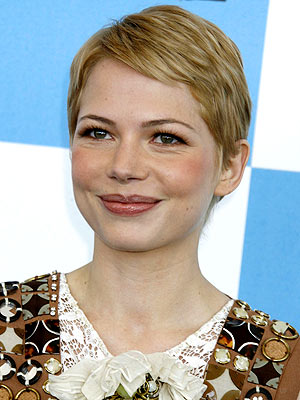
Michelle Williams’ New Haircut. Okay, most importantly: Should I get my hair cut like this?
Travels. Here are the places I’ve been in 2007: Chicago; Puerto Vallarta (Mexico); Osage Beach, MO; St. Louis, MO; Atchison, KS; Louisville, KY; New York City; Tucson, AZ; Columbus, OH; Lawrence, KS; Green Bay, WI; Minocqua, WI
Anti-Materialism. I try to be anti-materialistic. I believe in being happy with the bare minimum because I believe that it is the goal of big companies to convince you that what you’ve got isn’t any good. For example, Apple tries to convince you that your Ipod is old and out-of-date, thus conning you into buying a new one. So I try to be happy with what I’ve got. My cell phone, for example, is pretty ancient. I kept my last laptop for three years. But I seem to keep getting stymied in my anti-materialism by things breaking. I would have happily gone on with my old laptop except that the battery and power cord gave out (which is something, considering both survived the Fire of ’06, plugged in on the power strip right next to the pyromaniacal air conditioner). I can be satisfied with a computer that doesn’t burn DVDs; I cannot be happy with a computer that only stays on for an hour at a time. How is one supposed to be satisfied with what one’s got when it keeps breaking?
The State of Contemporary Fiction and Taco Bell. I recently read Ian McEwan’s Saturday and I didn’t like it, despite the fact that it’s received rave critical reviews. This book suffered from a problem I see everywhere in contemporary fiction – it elevates the mundane to the majestic with really no purpose except metaphor. The result is descriptions like this one of a squash match (though the close-third person narrator): “Every point is now a drama, a playlet of sudden reversals” (115) and the main character is full of “seriousness and fury” as well as “the incredible urge to win, biological as thirst” (115). And though I’ve never played squash, I read that and think, “Really? You’re in a squash match thinking of phrases like ‘seriousness and fury’?” Because I’ve sat and stared at a blinking cursor for hours and never come up with anything half as poetic as “seriousness and fury.” I’m not even convinced that Ian McEwan himself would think something like that such a situation. Or take his description of a smell” “like warm hay drying in the fields in August.” I get that a character might smell something and think it smells like hay, even drying hay. But the specificity of warm hay? In fields? In August? Now, there’s several problems here, foremost that McEwan isn’t considering his character’s point of view, but what I’m concerned with is the fact of window dressing. McEwan feels the postmodern impulse to represent the mundane (and rejects the modern impulse to be grandiose or epic), but he still wants to write in an epic style. He uses his prose to elevate the mundane. Why? Because people’s lives are boring, but fiction can’t be.
I’m connecting this to Taco Bell, and then I’ll finish my point. Really everything at Taco Bell is some combination of the same ingredients: cheese, meat, shell, lettuce. And yet Taco Bell has like 50 incarnations of these ingredients on their menu to convince you that there’s always something new:, Gordita, Chalupa, that thing that is shaped like a stop sign and you can apparently eat anywhere! They’ve even convinced you of Fourthmeal – a whole extra meal of the day for eating the same damn thing! Anyway, I feel like McEwan’s problem is that he’s really just taking taco parts and marketing them as a Crunchwrap Supreme. I read the above section of his book, and I’m thinking “squash game” and he’s thinking “metaphor for the struggle for male dominance in society as manifested in competitive sports” or something, and no amount of fancy writing is able to convince me otherwise.
“But Faith, isn’t that pretty anti-postmodern of you to say that a squash game is just a squash game? Doesn’t that imply that there’s some kind of Objective Reality out there?”
I guess I’m arguing that McEwans’ primary problem is that he describes everything with such intensity and Significance that it rings false. The premise of Saturday is that it’s one day in the life (one Saturday) of the main character and in order to justify why he’s chosen this Saturday as opposed to any other day, McEwan creates passages like the one above. I’m arguing that if you’re going to write about A Day in the Life, you need to have a really good reason as to why you’ve picked that day.
Early Rising. When I move to Arizona, I want to start getting up earlier. Like 5am early. I’m just noting this here so there’s some means of accountability.
Saturday, June 2, 2007
More Kinks in My GTD System
Getting Things Done recommends that you simplify, simplify, simplify by focusing on what your big goals are and only doing the tasks that help you accomplish those goals. I recently complained to Jennifer, my shiny new roommate that I had problems knowing what my goals were. Just like the GTD system seemed to be biased towards corporate types, it also seems to be biased towards people who know more than I do what they want out of life. For example:
Faith’s Goal #1: Be a professor. Okay, that sounds like a good goal, except if I really think about it, it’s pretty fuzzy. A professor where? A big university (such as those I’ve attended thus far)? A teaching college? (Jennifer recommends Truman – thanks Jennifer!) Do I want to teach graduate students or undergraduates? And what if I want to be a writing program administrator? Do I want to do administrative work? And maybe I don’t want to be a professor – I’ve also thought about teaching at a private high school or boarding school. What if I end up disenfranchised with the system of higher ed? Also, I was reading this article in Newsweek and it sounds like these schools could be cool places to work. And what is this “professor” identity anyway? What if my goal to be a professor conflicts with a goal to be a teacher or advisor or dean or chair? Or wife, mother, friend, humanitarian, pet owner, American Idol finalist ….
Another kink in the system is that little things don’t go away just because you don’t focus on them. For example, this semester I did a good job of saying to myself that my thesis was absolutely the number one most important thing (in GTD speak, that’s an MIT or Most Important Task). So when I had a free hour or two and I was trying to figure out what to do, I always went to the thesis. This meant that my thesis got done. But that did not, in fact, make other things go away. Papers did not grade themselves. So while it was great that the thesis went well, I was plagued with a lot of loose ends.
Faith’s Goal #1: Be a professor. Okay, that sounds like a good goal, except if I really think about it, it’s pretty fuzzy. A professor where? A big university (such as those I’ve attended thus far)? A teaching college? (Jennifer recommends Truman – thanks Jennifer!) Do I want to teach graduate students or undergraduates? And what if I want to be a writing program administrator? Do I want to do administrative work? And maybe I don’t want to be a professor – I’ve also thought about teaching at a private high school or boarding school. What if I end up disenfranchised with the system of higher ed? Also, I was reading this article in Newsweek and it sounds like these schools could be cool places to work. And what is this “professor” identity anyway? What if my goal to be a professor conflicts with a goal to be a teacher or advisor or dean or chair? Or wife, mother, friend, humanitarian, pet owner, American Idol finalist ….
Another kink in the system is that little things don’t go away just because you don’t focus on them. For example, this semester I did a good job of saying to myself that my thesis was absolutely the number one most important thing (in GTD speak, that’s an MIT or Most Important Task). So when I had a free hour or two and I was trying to figure out what to do, I always went to the thesis. This meant that my thesis got done. But that did not, in fact, make other things go away. Papers did not grade themselves. So while it was great that the thesis went well, I was plagued with a lot of loose ends.
Sunday, May 27, 2007
A Story I Have Heard Before
There is a girl, typically a high school girl, often aged 16 or so, ALWAYS with hair described as “mousy brown.” Her looks are “ordinary.” She is awkward, which we know because she is frequently doing things like getting books out of her locker and spilling them all over the floor (oops!). She has few, if any, friends and on more than one occasion a popular blonde girl has made fun of her, typically to the amusement of her popular blonde friends.
But don’t worry about her! Because no sooner have we established her extreme dork factor by having her read Tolstoy on the school bus, than the “handsomest boy in school” performs some sort of heroic act. He picks up her books when she drops them, he catches her when she faints, performs the Heimlich maneuver after she’s downed an errant grilled cheese, swims out to save her from drowning in a polka-dot bathing suit. Like all good men throughout time, he “saves” her. As it turns out, he’s witty and charming, and although he easily talks to her, her hands are “clammy,” stomach definitively full of “butterflies,” and stammering is always involved. She is in disbelief that this handsome creature has deigned to acknowledge her existence. Though I know I’ve seen this conceit a million places, the specific examples I can think of here are season one of Gilmore Girls, a book I just read called Prep, and at some point in Ugly Betty.
This storyline is wrong to me for a number of reasons. Number One, as a certified ordinary Mousy Brown in high school, who read on the school bus and was regularly in need of saving, this kind of thing NEVER HAPPENED TO ME. Pretty blonde girls need saving all the time, and there just isn’t enough teenage boy heroism to go around. The second thing that’s wrong here is that teenage boys are some of the least witty and charming human beings on the planet (and they never have skin as good as Jared Padalecki’s). Finally: Why can’t mousy brown just be okay? Why does she need the basketball captain to fall in love with her? The only answer I can come up with is that society has determined that dorky women need the handsomest boy to be Okay. Somehow, a teenage boy falling in love with you validates your existence.
These were the ideas going through my head last night as I read Prep, by Curtis Sittenfeld, a hum-drum book about a girl named Lee who goes to an elite East Coast boarding school. I had heard great things about the book by people who know stuff about books. This book annoyitated me for several reasons. First, the main character is a poorly disguised stand-in for the author, whose mousy brown mug can be found on the back flap. The main character’s name is “Lee” and she’s a girl. And the author’s name is “Curtis” and she too is a girl. Get it? The book’s chapters are divided up by the semesters at school and each chapter could basically be called “funny stuff that happened this one time” because the stories in each rarely intersect in any kind of meaningful way, save for the fact that they seem to happen to the same bunch of characters (same characters doth not plot continuity make). And what happens (“plot”), like everything that happens in high school, is basically meaningless. What I’ve always found appealing about the teenage narrator is that everything seems really important – this is an easy way to give a story significance. In high school, everything always feels like the end of the world. But Sittenfeld is desperate to show you how she’s Come So Far since those silly high school days, that she occasionally, much to the vertigo of the reader, inserts Wise Reflections telling you just how little the moment actually means in the Grand Scheme of Things (Message!). Essentially, she sets up all the drama of a scene, assembles its characters, executes it well, but then deflates it. For example, there’s a quite compelling scene where Lee’s parents come visit her at school and she’s snotty to them. Her father slaps her and tells her that she’s become an east coast snob, and has forgotten her Indiana roots. Immediately following this scene, there are three pages of narration saying (1) that the family laughed about it in retrospect (2) that her father never hit her again (3) that she and her father eventually became very close. So you’re left wondering, why did you tell me this? Teenagers have no perspective, which is why they’re fun to write with – the author doesn’t have to worry about not placing enough gravity in the situation, because with teenagers, everything has gravity. Unless, after every single scene that might mean something, an Older Self dues ex machinas her way into the narrative to tell you it didn’t really mean anything after all. I can just imagine this in Catcher in the Rye (which this book is compared to in a cringe-worthy blurb on the back from Wally Lamb). “Gee, I was so alienated and cynical at the time. I felt that everything was phony. In retrospect, I realize the value of human existence.” (To be fair, Holden does narrate in retrospect, but it’s only a year later, and he’s in a psych ward for crying out loud, where Prep’s narrator seems to be lodged in happily married suburbia, post-college). The grown-up voice also just feels like a cop-out – the writer is too lazy to stay with the voice and let it carry the story.
Anyway, I recently read a fantastic teenage narrative in Marisha Pessl’s Special Topics in Calamity Physics which is full of pop culture and literature references, and if you haven’t read it already, please drop what you are doing and proceed directly to Amazon.com, where you too can experience this book for a mere $6.15. I read this book almost a week ago and I can’t stop thinking about it. In fact, that’s why I haven’t blogged about it yet, because it seemed to render me speechless. More later!
But don’t worry about her! Because no sooner have we established her extreme dork factor by having her read Tolstoy on the school bus, than the “handsomest boy in school” performs some sort of heroic act. He picks up her books when she drops them, he catches her when she faints, performs the Heimlich maneuver after she’s downed an errant grilled cheese, swims out to save her from drowning in a polka-dot bathing suit. Like all good men throughout time, he “saves” her. As it turns out, he’s witty and charming, and although he easily talks to her, her hands are “clammy,” stomach definitively full of “butterflies,” and stammering is always involved. She is in disbelief that this handsome creature has deigned to acknowledge her existence. Though I know I’ve seen this conceit a million places, the specific examples I can think of here are season one of Gilmore Girls, a book I just read called Prep, and at some point in Ugly Betty.
This storyline is wrong to me for a number of reasons. Number One, as a certified ordinary Mousy Brown in high school, who read on the school bus and was regularly in need of saving, this kind of thing NEVER HAPPENED TO ME. Pretty blonde girls need saving all the time, and there just isn’t enough teenage boy heroism to go around. The second thing that’s wrong here is that teenage boys are some of the least witty and charming human beings on the planet (and they never have skin as good as Jared Padalecki’s). Finally: Why can’t mousy brown just be okay? Why does she need the basketball captain to fall in love with her? The only answer I can come up with is that society has determined that dorky women need the handsomest boy to be Okay. Somehow, a teenage boy falling in love with you validates your existence.
These were the ideas going through my head last night as I read Prep, by Curtis Sittenfeld, a hum-drum book about a girl named Lee who goes to an elite East Coast boarding school. I had heard great things about the book by people who know stuff about books. This book annoyitated me for several reasons. First, the main character is a poorly disguised stand-in for the author, whose mousy brown mug can be found on the back flap. The main character’s name is “Lee” and she’s a girl. And the author’s name is “Curtis” and she too is a girl. Get it? The book’s chapters are divided up by the semesters at school and each chapter could basically be called “funny stuff that happened this one time” because the stories in each rarely intersect in any kind of meaningful way, save for the fact that they seem to happen to the same bunch of characters (same characters doth not plot continuity make). And what happens (“plot”), like everything that happens in high school, is basically meaningless. What I’ve always found appealing about the teenage narrator is that everything seems really important – this is an easy way to give a story significance. In high school, everything always feels like the end of the world. But Sittenfeld is desperate to show you how she’s Come So Far since those silly high school days, that she occasionally, much to the vertigo of the reader, inserts Wise Reflections telling you just how little the moment actually means in the Grand Scheme of Things (Message!). Essentially, she sets up all the drama of a scene, assembles its characters, executes it well, but then deflates it. For example, there’s a quite compelling scene where Lee’s parents come visit her at school and she’s snotty to them. Her father slaps her and tells her that she’s become an east coast snob, and has forgotten her Indiana roots. Immediately following this scene, there are three pages of narration saying (1) that the family laughed about it in retrospect (2) that her father never hit her again (3) that she and her father eventually became very close. So you’re left wondering, why did you tell me this? Teenagers have no perspective, which is why they’re fun to write with – the author doesn’t have to worry about not placing enough gravity in the situation, because with teenagers, everything has gravity. Unless, after every single scene that might mean something, an Older Self dues ex machinas her way into the narrative to tell you it didn’t really mean anything after all. I can just imagine this in Catcher in the Rye (which this book is compared to in a cringe-worthy blurb on the back from Wally Lamb). “Gee, I was so alienated and cynical at the time. I felt that everything was phony. In retrospect, I realize the value of human existence.” (To be fair, Holden does narrate in retrospect, but it’s only a year later, and he’s in a psych ward for crying out loud, where Prep’s narrator seems to be lodged in happily married suburbia, post-college). The grown-up voice also just feels like a cop-out – the writer is too lazy to stay with the voice and let it carry the story.
Anyway, I recently read a fantastic teenage narrative in Marisha Pessl’s Special Topics in Calamity Physics which is full of pop culture and literature references, and if you haven’t read it already, please drop what you are doing and proceed directly to Amazon.com, where you too can experience this book for a mere $6.15. I read this book almost a week ago and I can’t stop thinking about it. In fact, that’s why I haven’t blogged about it yet, because it seemed to render me speechless. More later!
Wednesday, May 23, 2007
Dissertation Idea
Okay, so it’s a little early to think about a dissertation (hello, Faith In Five Years!) but I’ve been inspired by a book I just read: Rebekah Nathan’s My Freshman Year. Nathan – a pseudonym – was a professor or anthropology at a large state university, and felt that she was disconnected from her students. They fell asleep in class, didn’t do the reading, and basically didn’t seem to care much about school. So she decided to investigate undergraduate culture from their point of view – she moved into a dorm and enrolled for a full freshman courseload.
I greatly admire Nathan’s ambition. In fact, this is something I can say for anthropological ethnographers that I can’t say for composition ethnographers – they put themselves out there. They take risks. I would love to do a project like this, except instead of aiming to discover all of undergraduate culture, I would be more interested in learning about how the freshman experience relates to student writing. How does the freshman composition course compare to the other courses the students are taking? How does the intellectual activity of writing fit in with their other activities? Where does comp fall in their list of priorities? Nathan took five classes with five professors and three teaching assistants, which meaning that in one semester there were eight people making rules and structuring her day. It’s little wonder that students feel overwhelmed trying to meet so many different expectations. Since writing is always “for an audience” I wonder how these different demands influence students’ writing as well.
Nathan discusses some interesting ethical issues she faced: with very few exceptions, she didn’t reveal her true identity. She even paid for the whole thing herself so she wouldn’t have to turn over her notes to anyone. I think I would have an advantage over also be able to pass for a freshman, whereas Nathan was in her fifties. I wonder, however, if I’m not distanced enough from the culture to see it objectively.
Some of Nathan’s insights:
Students are working more than they ever have (or have had to) in the past, and their jobs not only take up a large part of their time but also play a large role in their social lives. A student once told me that she kept missing my class because she had to work late and this made her either (1) tired or (2) sick. And she had to work forty hours a week to pay for school. Though I sympathized, I wondered why she was working so hard to pay for classes she didn’t go to.
Nathan believes that the lack of “community” on typical college campuses (e.g. poorly attended hall events) stems from the overabundance of competing options as to how students can spend their time. She explains “it is hard to create a community when the sheer number of options in college life generate a system in which no one is in the same place at the same time” (38. Students can choose where to live, their major, their extracurriculars, their classes, where to eat, what to do with their free time, where to study, etc. This has gotten to the point where just because you go to the same school as someone doesn’t mean you have anything in common. She writes, “Seen from the level of the institution, ‘community’ is a lofty ideal but with few common activities, rituals, or even symbols to bind together its diverse inhabitants” (40).
Besides work friends, students also seem to form networks based on “shared circumstances and shared demographics” rather than “personality” (57). I thought this happened just at UW because classes were so large, but she reports that in her research “classroom contacts figured relatively little into the social networks of students” (57). In fact, “the most significant relationships are formed either before college or either very early on in one’s college career, most often in some shared affiliation, whether voluntary or not, such as freshman dorm assignment, special freshman summer program, ROTC, ethnic club, or sorority and fraternity rush” (58).
She has some great ideas about why students are hesitant to speak in class. “Equality” is an unconscious norm of the classroom, meaning that students strive not to be “too noticeable . . . It is fine to do well in a class, performing better than others, but only if you do it unobtrusively” (91). She links this to campus activism that doesn’t engage in dialogue with anyone, despite its attempt to be “in your face.” I was thinking of Bascom Hill at UW-Madison, which was variously littered with signs, crosses, pink flamingoes, all in the vague name of “awareness-raising.” Nathan calls these “assertion without direct dialogue, an ‘in your face’ argument without a real face at the other end” (96).
Nathan also points to the depressing reality that “academic life is tangential or at odds with peer culture,” which as been a finding of many studies of campus culture. When she wandered the halls of the dorm, students were talking about sex or boys or drinking. Aside from meetings, like those for group projects, “none of the talk . . . concerned either the substantive content of a class or any other topic that might be labeled academic or intellectual” (99). This also offers an explanation for why students don’t seem to think it’s a big deal to miss class or not do their work. If academic isn’t the number one priority in their lives, it makes sense to them that going home for Easter or being sick or drinking with their friends is a good reason skip school. She said that one of her most sobering insights was that intellectual life just didn’t matter that much in college.
Ultimately, Nathan argues that college needs to be a site of “liminality” or a rite of passage for students. In order to do so, it must resist the world, which is becoming more market-driven (hence the multitude of options for students. She says, “we would not want a university to become so immersed in the world that it can neither critique that world nor proffer an ideal vision of how else it might be” (153).
I greatly admire Nathan’s ambition. In fact, this is something I can say for anthropological ethnographers that I can’t say for composition ethnographers – they put themselves out there. They take risks. I would love to do a project like this, except instead of aiming to discover all of undergraduate culture, I would be more interested in learning about how the freshman experience relates to student writing. How does the freshman composition course compare to the other courses the students are taking? How does the intellectual activity of writing fit in with their other activities? Where does comp fall in their list of priorities? Nathan took five classes with five professors and three teaching assistants, which meaning that in one semester there were eight people making rules and structuring her day. It’s little wonder that students feel overwhelmed trying to meet so many different expectations. Since writing is always “for an audience” I wonder how these different demands influence students’ writing as well.
Nathan discusses some interesting ethical issues she faced: with very few exceptions, she didn’t reveal her true identity. She even paid for the whole thing herself so she wouldn’t have to turn over her notes to anyone. I think I would have an advantage over also be able to pass for a freshman, whereas Nathan was in her fifties. I wonder, however, if I’m not distanced enough from the culture to see it objectively.
Some of Nathan’s insights:
Students are working more than they ever have (or have had to) in the past, and their jobs not only take up a large part of their time but also play a large role in their social lives. A student once told me that she kept missing my class because she had to work late and this made her either (1) tired or (2) sick. And she had to work forty hours a week to pay for school. Though I sympathized, I wondered why she was working so hard to pay for classes she didn’t go to.
Nathan believes that the lack of “community” on typical college campuses (e.g. poorly attended hall events) stems from the overabundance of competing options as to how students can spend their time. She explains “it is hard to create a community when the sheer number of options in college life generate a system in which no one is in the same place at the same time” (38. Students can choose where to live, their major, their extracurriculars, their classes, where to eat, what to do with their free time, where to study, etc. This has gotten to the point where just because you go to the same school as someone doesn’t mean you have anything in common. She writes, “Seen from the level of the institution, ‘community’ is a lofty ideal but with few common activities, rituals, or even symbols to bind together its diverse inhabitants” (40).
Besides work friends, students also seem to form networks based on “shared circumstances and shared demographics” rather than “personality” (57). I thought this happened just at UW because classes were so large, but she reports that in her research “classroom contacts figured relatively little into the social networks of students” (57). In fact, “the most significant relationships are formed either before college or either very early on in one’s college career, most often in some shared affiliation, whether voluntary or not, such as freshman dorm assignment, special freshman summer program, ROTC, ethnic club, or sorority and fraternity rush” (58).
She has some great ideas about why students are hesitant to speak in class. “Equality” is an unconscious norm of the classroom, meaning that students strive not to be “too noticeable . . . It is fine to do well in a class, performing better than others, but only if you do it unobtrusively” (91). She links this to campus activism that doesn’t engage in dialogue with anyone, despite its attempt to be “in your face.” I was thinking of Bascom Hill at UW-Madison, which was variously littered with signs, crosses, pink flamingoes, all in the vague name of “awareness-raising.” Nathan calls these “assertion without direct dialogue, an ‘in your face’ argument without a real face at the other end” (96).
Nathan also points to the depressing reality that “academic life is tangential or at odds with peer culture,” which as been a finding of many studies of campus culture. When she wandered the halls of the dorm, students were talking about sex or boys or drinking. Aside from meetings, like those for group projects, “none of the talk . . . concerned either the substantive content of a class or any other topic that might be labeled academic or intellectual” (99). This also offers an explanation for why students don’t seem to think it’s a big deal to miss class or not do their work. If academic isn’t the number one priority in their lives, it makes sense to them that going home for Easter or being sick or drinking with their friends is a good reason skip school. She said that one of her most sobering insights was that intellectual life just didn’t matter that much in college.
Ultimately, Nathan argues that college needs to be a site of “liminality” or a rite of passage for students. In order to do so, it must resist the world, which is becoming more market-driven (hence the multitude of options for students. She says, “we would not want a university to become so immersed in the world that it can neither critique that world nor proffer an ideal vision of how else it might be” (153).
Saturday, May 19, 2007
GTD and Me
I recently read David Allen’s Getting Things Done (GTD). Allen has received a lot of buzz for his system of productivity, and many blogs (two of my favorites are Lifehack.org and zenhabits.com) are devoted to ways that people can implement the system in their lives for maximum productivity. For example, Allen recommends taking all the open projects in your life and breaking them down into “next actions” or “the next physical, visible activity that needs to be engaged in, in order to move the current reality toward completion” (34). So for example if you need to get your oil changed, your next action might be to call the garage to see when it’s open and how much it costs. Allen also recommends categorizing these actions by their locations, so you’d have a next action list for “@Home” “@Work” “@Errands” etc.
I found Allen’s book incredibly useful and I would recommend it and the above blogs to anyone, but I’m concerned that his ideas are more applicable to Corporate America types as opposed to graduate students. He talks a lot about faxes, meetings, agendas, organizing one’s “office” – these are not the essence of what a grad student deals with everyday. What I’ve found difficult with implementing this system is the physicality of it all – Allen stresses that you need to think of things in terms of the next physical action, but I feel like a lot of what I do in grad school is internal and mental (perhaps this causes procrastination?) For example, say I’m writing a paper. I could put on my next actions list: Write one page of paper. But that’s not really how I write. My style is very recursive, so although I may have written a page, it’s likely that very little of that will contribute to what Allen calls completion. In fact, I could babble for a page. Sometimes I think my next action is “Stare into blinking cursor” or “Think of title” neither of which are especially physical actions.
I do think that I could teach some GTD principles in a freshman composition course. Allen writes that we procrastinate because we start to imagine all the things that could possibly go wrong (this is why sensitive and imaginative people are especially prone to procrastination). He says that we just need to start plodding along and making things happen instead of worrying about the end point. Many students in a freshman composition course have not had good experiences with writing in the past, so when I assign the first paper, they are instantly filled with anxiety (“It’ll never be good enough” “Mrs. Horrible Sophomore English Teacher hated everything I wrote”) and thus procrastinate. But what if we could break down the paper into a series of next actions? Would this relieve the anxiety? For example, it might go something like this
1. Get together notes from class, assignment sheet
2. Brainstorm three topics
3. Choose a topic based on guidelines in class
4. Find three quotes I want to use
5. Write thesis statement
6. Make outline based on thesis statement
WOW! I already have less anxiety! Now this is not to say that the students wouldn’t encounter the same problem that I mentioned above, but I think that a set of physical actions would at least get them started. Plus, looking back at that list now, I realize that “staring off into space” and “thinking” are mental actions that are kind of embedded in the physical actions of creating a thesis statement or outline.
I found Allen’s book incredibly useful and I would recommend it and the above blogs to anyone, but I’m concerned that his ideas are more applicable to Corporate America types as opposed to graduate students. He talks a lot about faxes, meetings, agendas, organizing one’s “office” – these are not the essence of what a grad student deals with everyday. What I’ve found difficult with implementing this system is the physicality of it all – Allen stresses that you need to think of things in terms of the next physical action, but I feel like a lot of what I do in grad school is internal and mental (perhaps this causes procrastination?) For example, say I’m writing a paper. I could put on my next actions list: Write one page of paper. But that’s not really how I write. My style is very recursive, so although I may have written a page, it’s likely that very little of that will contribute to what Allen calls completion. In fact, I could babble for a page. Sometimes I think my next action is “Stare into blinking cursor” or “Think of title” neither of which are especially physical actions.
I do think that I could teach some GTD principles in a freshman composition course. Allen writes that we procrastinate because we start to imagine all the things that could possibly go wrong (this is why sensitive and imaginative people are especially prone to procrastination). He says that we just need to start plodding along and making things happen instead of worrying about the end point. Many students in a freshman composition course have not had good experiences with writing in the past, so when I assign the first paper, they are instantly filled with anxiety (“It’ll never be good enough” “Mrs. Horrible Sophomore English Teacher hated everything I wrote”) and thus procrastinate. But what if we could break down the paper into a series of next actions? Would this relieve the anxiety? For example, it might go something like this
1. Get together notes from class, assignment sheet
2. Brainstorm three topics
3. Choose a topic based on guidelines in class
4. Find three quotes I want to use
5. Write thesis statement
6. Make outline based on thesis statement
WOW! I already have less anxiety! Now this is not to say that the students wouldn’t encounter the same problem that I mentioned above, but I think that a set of physical actions would at least get them started. Plus, looking back at that list now, I realize that “staring off into space” and “thinking” are mental actions that are kind of embedded in the physical actions of creating a thesis statement or outline.
Subscribe to:
Posts (Atom)